
Famous Computer Pioneers and Milestones
Famous Computer Pioneers and Milestones. Foundational Computer Awareness explanations, examples and explained practice questions for banking and recruitment exam preparation.
By Akhilesh Saini
Learning objectives
Associate computing pioneers with their actual contributions, place a short set of historical events in broad chronological order, and understand why “the first computer” often needs qualification.
Why history appears in computer-awareness exams
Historical questions are usually recognition questions: Who proposed the Analytical Engine? Who created the Web? Which researcher is strongly linked with early compilers? These are worth memorizing, but blanket claims about a single inventor of the computer can be wrong. Computing developed through mechanical calculation, mathematical theories, electromechanical devices, electronic circuits, stored-program designs, programming languages and interconnected networks. Many innovations were collaborative.
People and contributions you should recognize
| Pioneer or team | Reliable association | Avoid saying… |
|---|---|---|
| Charles Babbage | Designed the Difference Engine and conceptualized the programmable Analytical Engine in the nineteenth century | That the Analytical Engine was completed as an operational electronic computer |
| Ada Lovelace | Published extensive notes (1843) describing procedures for the Analytical Engine, including a Bernoulli-number method | That she operated a completed Analytical Engine |
| Alan Turing | Theoretical basis of computation, including the universal machine idea in 1936; major wartime codebreaking contribution | That he alone physically built the first electronic computer |
| John von Neumann | Widely circulated 1945 EDVAC report articulating stored-program computer architecture | That stored-program computing was entirely a one-person invention |
| Konrad Zuse | Early programmable binary computing machines, including Z3 | That all other definitions of an early computer are irrelevant |
| J. Presper Eckert and John Mauchly | Principal designers of ENIAC, a major general-purpose electronic digital computer | That ENIAC was the first computer of every possible kind |
| Grace Hopper | Pioneering compiler work including A-0; influential in development of business-oriented languages and COBOL | That she personally wrote all of COBOL alone |
| John Backus and IBM team | Led work on FORTRAN, prominent early high-level language for scientific computing | That FORTRAN was the first programming language of any sort |
| Dennis Ritchie | Central creator of the C programming language; co-developer of Unix | That he alone created all of Unix |
| Ken Thompson | Key creator of Unix alongside colleagues | That Unix is identical to Linux |
| Vint Cerf and Robert Kahn | Foundational work on internetworking protocol design leading to TCP/IP | That either person alone invented the entire Internet |
| Tim Berners-Lee | Invented the World Wide Web at CERN, beginning with a 1989 proposal | That he invented the Internet itself |
| Ray Tomlinson | Major early contribution to network email and use of @ in network mail addresses | That there were no electronic messages before network email |
| Herman Hollerith | Punched-card tabulation used in population-census processing | That his machines were modern general-purpose electronic computers |
| George Boole | Algebra of logic, fundamental to digital Boolean operations | That he invented electronic logic gates |
| Claude Shannon | Connected Boolean logic with switching-circuit design and advanced information theory | That Boolean algebra began with Shannon |
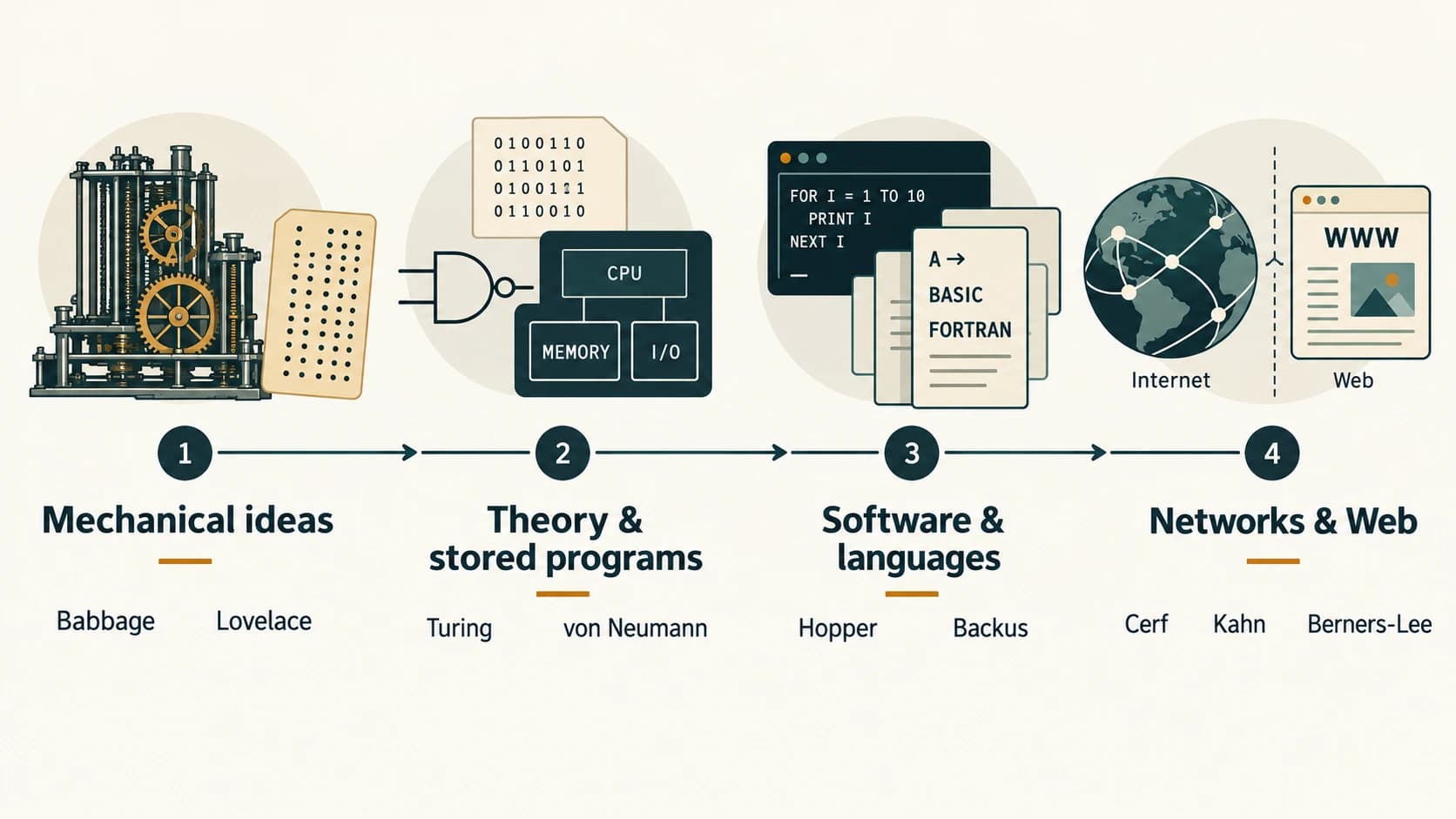
A mental timeline: Babbage and Lovelace belong to mechanical programmable-machine concepts; Boole to logic; Turing to the mathematical model; early twentieth-century machine builders to practical programmable and electronic computers; Hopper, Backus and Unix developers to programming/software; Kahn, Cerf and Berners-Lee to network protocols and the Web.
Milestones and what their dates mean
Historical dates below are events that form part of the subject, not document-publication or update metadata.
| Milestone | Date/period | Why it matters |
|---|---|---|
| Babbage develops the Analytical Engine concept | 1830s | Design for a general-purpose programmable mechanical machine |
| Lovelace publishes extensive Analytical Engine notes | 1843 | Early published programming-like procedure descriptions |
| Turing describes a universal computing-machine model | 1936 | Foundational theory of computation |
| First Draft of a Report on the EDVAC circulated | 1945 | Major articulation of stored-program design |
| ENIAC publicly unveiled | 1946 | Landmark programmable general-purpose electronic computing system |
| Transistor demonstrated at Bell Labs | 1947 | Key component in the shift away from vacuum tubes |
| Manchester Baby runs a stored program | 1948 | Early successful electronic stored-program demonstration |
| UNIVAC I delivered/commercially introduced | 1951 | Major early commercial computing system in the United States |
| Hopper's A-0 system completed | 1952 | Landmark work in early compilation/programming tools |
| FORTRAN appears | 1957 | Important higher-level scientific programming language |
| ARPANET's early network connects sites | 1969 | Major milestone in packet-network development |
| ARPANET adopts TCP/IP for internetworking | 1983 | Important step toward the modern Internet |
| Tim Berners-Lee proposes the Web at CERN | 1989 | Origin of the World Wide Web project |
| First Web browser/editor and server operating at CERN | 1990 | Functional early Web implementation |
| PARAM 8000 developed by C-DAC | Early 1990s | Major milestone in India's indigenous supercomputing programme |
Three common “first” traps
- “First computer” can refer to mechanical, electronic, general-purpose, programmable or stored-program systems. Different qualifications yield different answers; a slogan without a qualifier is unsafe.
- Internet versus World Wide Web: Packet networking existed well before the Web project. Berners-Lee's achievement is the Web, not invention of all networks.
- “First programmer” and Ada Lovelace: She is conventionally associated with the first published program-like account for a general-purpose computing machine, but the engine was not built and priority descriptions require nuance.
India-focused historical perspective
C-DAC (Centre for Development of Advanced Computing) established an indigenous high-performance-computing programme that produced the PARAM series, with PARAM 8000 as a foundational early model. The central exam fact is the association PARAM → C-DAC → Indian supercomputing. Do not memorize an unqualified claim that it was the first computing machine ever built in India. For other computing pioneers, associate contributions with a specific idea, system or technology, not a dramatic title alone.
Worked recognition examples
Example 1: “Who invented the World Wide Web?” → Tim Berners-Lee. If the question instead asks about TCP/IP's design, think Vint Cerf and Robert Kahn, not Berners-Lee.
Example 2: “Which person is associated with the Analytical Engine?” → Charles Babbage. If it refers specifically to the famous 1843 published notes with a procedure, answer Ada Lovelace.
Example 3: “Who is linked to early compilers and business-oriented language development?” → Grace Hopper. If the question asks for the language whose IBM team was led by John Backus, answer FORTRAN.
Quick revision
Babbage—Analytical Engine; Lovelace—1843 notes; Turing—universal machine; von Neumann—stored-program architecture report; Eckert/Mauchly—ENIAC; Hopper—early compiler; Backus—FORTRAN; Cerf/Kahn—TCP/IP; Berners-Lee—Web; Tomlinson—network email; C-DAC—PARAM.
Practice MCQs — CA-11-02
1. Who is most closely associated with the proposed Analytical Engine?
A. Charles Babbage
B. Tim Berners-Lee
C. John Backus
D. Ray Tomlinson
2. Ada Lovelace is especially known for which contribution?
A. Inventing the World Wide Web
B. Published notes explaining procedures for Babbage’s Analytical Engine
C. Building the first commercial microprocessor
D. Creating Ethernet switches
3. Who published the universal computing-machine theory associated with 1936?
A. Dennis Ritchie
B. Herman Hollerith
C. Alan Turing
D. John Mauchly
4. Which early-computing pair is most strongly linked with ENIAC?
A. Vint Cerf and Robert Kahn
B. Ken Thompson and Dennis Ritchie
C. John Backus and Grace Hopper
D. J. Presper Eckert and John Mauchly
5. Which pioneer is associated with A-0 and early compiler systems?
A. Grace Hopper
B. Charles Babbage
C. George Boole
D. Tim Berners-Lee
6. Which language is particularly associated with an IBM group led by John Backus?
A. HTML
B. FORTRAN
C. SQL
D. XML
7. Whose 1945 EDVAC report helped popularize a stored-program architecture?
A. Ada Lovelace
B. Ray Tomlinson
C. John von Neumann
D. Claude Shannon
8. Which pair is commonly associated with foundational TCP/IP protocol work?
A. Babbage and Lovelace
B. Ritchie and Thompson
C. Eckert and Mauchly
D. Vint Cerf and Robert Kahn
9. Who proposed the World Wide Web while working at CERN?
A. Tim Berners-Lee
B. Alan Turing
C. Herman Hollerith
D. John Backus
10. Which person is associated with network email and the use of @ in addresses?
A. Charles Babbage
B. Ray Tomlinson
C. John von Neumann
D. Ken Thompson
11. Which Indian organization is associated with the PARAM supercomputing series?
A. ISRO as sole developer
B. NCERT
C. C-DAC
D. NPCI
12. Why is “ENIAC was the first computer” an incomplete revision fact?
A. ENIAC was only a word processor
B. All computers were invented after the Web
C. No electronic systems existed in the 1940s
D. Different definitions of computer and firstness produce different candidates
Answers and explanations — CA-11-02
1. A — Charles Babbage. Babbage conceived the general-purpose programmable mechanical Analytical Engine; it was not completed as a working electronic computer.
2. B — Published notes explaining procedures for Babbage’s Analytical Engine. Her 1843 notes contain early published program-like procedures; the proposed engine was not built in her lifetime.
3. C — Alan Turing. Turing formalized important ideas about computability; the theoretical model is not the same as inventing all hardware.
4. D — J. Presper Eckert and John Mauchly. Eckert and Mauchly were principal ENIAC designers, alongside a much larger team of builders and programmers.
5. A — Grace Hopper. Hopper’s A-0 was influential early compilation work, and she played an important part in the COBOL effort.
6. B — FORTRAN. John Backus led the IBM work that produced FORTRAN for scientific computing.
7. C — John von Neumann. The EDVAC report is strongly associated with von Neumann, but stored-program computing was a collaborative development.
8. D — Vint Cerf and Robert Kahn. Cerf and Kahn made foundational contributions to internetworking protocols; this is different from the origin of the Web.
9. A — Tim Berners-Lee. Berners-Lee developed the Web project at CERN; the Internet already existed as a networking system.
10. B — Ray Tomlinson. Tomlinson contributed a network email system and popularized user@host addressing in that context.
11. C — C-DAC. The Centre for Development of Advanced Computing developed the PARAM supercomputing programme.
12. D — Different definitions of computer and firstness produce different candidates. Mechanical, electronic, general-purpose, programmable and stored-program firsts are distinct claims.