
Windows, Linux, macOS, Android and iOS Basics
Windows, Linux, macOS, Android and iOS Basics. Foundational Computer Awareness explanations, examples and explained practice questions for banking and recruitment exam preparation.
By Akhilesh Saini
What you will learn
- Which operating systems are commonly associated with desktop/laptop and mobile devices.
- The distinction between the Linux kernel and a Linux distribution.
- What is meant by Unix-like, open source and proprietary in OS discussions.
- How not to confuse an operating system with a company, phone, desktop interface or application.
Why this topic matters
Some of the easiest-looking exam questions are tricky because they mix OS names, hardware brands and applications. "Which one is a mobile OS?" is easy only if you know whether the word refers to a platform, a device or an app.
Common operating-system families
| Operating system | Common association | Important point |
|---|---|---|
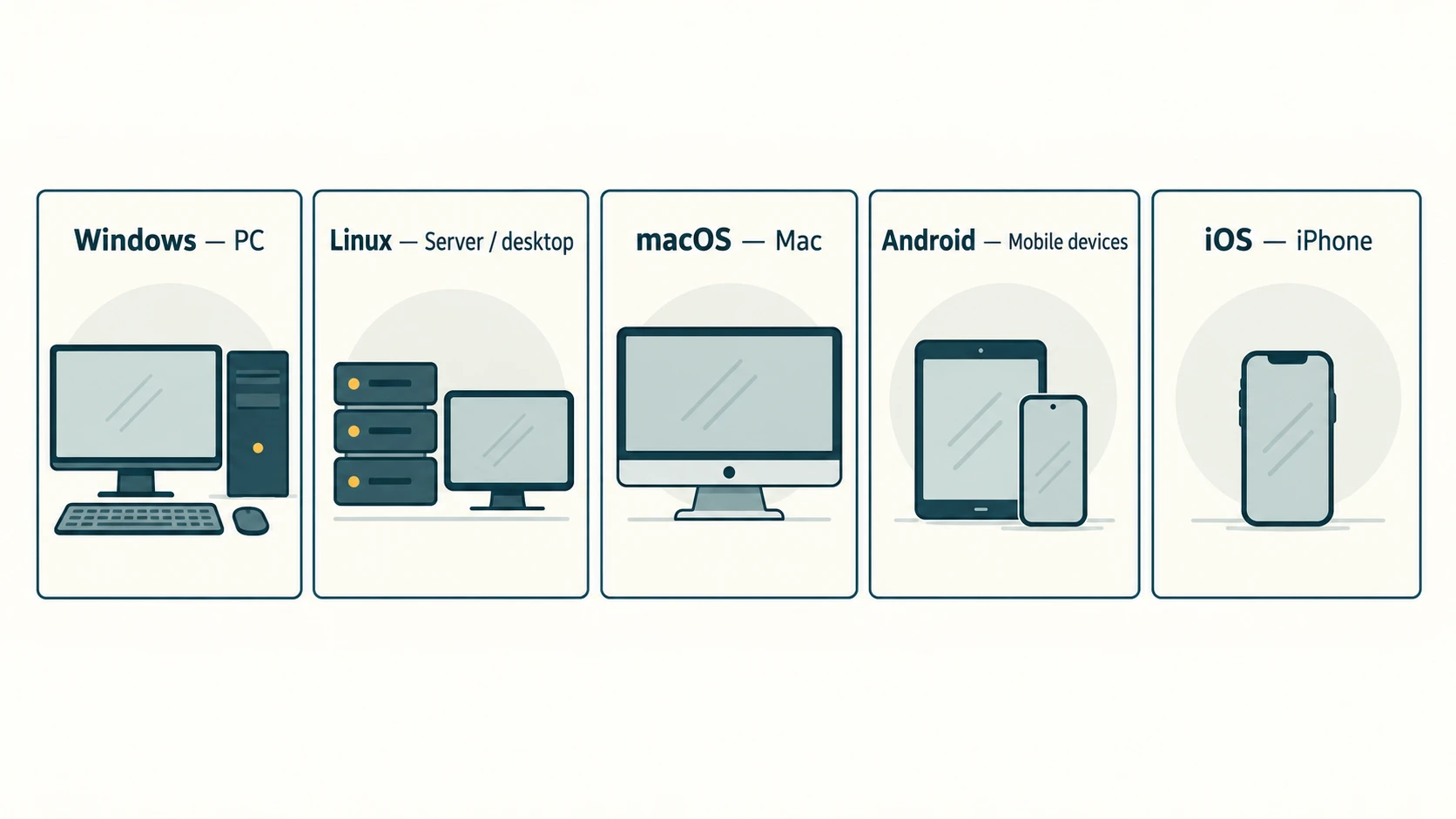
| Microsoft Windows | Desktop/laptop PCs, business and some server environments | Microsoft develops Windows; its versions and editions vary |
| Linux | Servers, desktops, embedded systems and many other devices | Technically a kernel; everyday "Linux OS" often means a distribution |
| Apple macOS | Apple's Mac computers | Unix-based/Unix-like desktop operating system |
| Android | Smartphones, tablets and other device types | Uses a Linux kernel; core open-source platform with device-specific additions |
| Apple iOS | iPhone | Apple's mobile operating system; distinct from macOS |
Remember: Device/platform examples can vary by model and release; the table describes typical associations, not absolute restrictions.
Windows
Windows is an operating-system family developed by Microsoft. It commonly provides desktop windows, taskbar-style navigation, file-management tools, account management and application support. Its everyday GUI makes many operations discoverable; command-line tools are also available. Windows is not synonymous with MS Word, Excel, Office, or every Microsoft program. Those are application products or suites.
Linux: kernel and distributions
Linux is the name of a widely used open-source kernel. A complete usable system generally includes the kernel plus many other software components; a packaged combination is called a Linux distribution (often "distro"). Examples include Ubuntu, Debian, Fedora and Linux Mint. Different distributions choose different desktop environments, packaging methods and utilities.
Important qualification: Linux systems are not inherently command-line only; some provide sophisticated graphical desktops. Linux is not the same thing as Android, although Android's foundation includes the Linux kernel.
macOS
macOS is Apple's desktop/laptop operating system for Mac computers. It is built on a Unix-based foundation and supports graphical desktop applications as well as a terminal. Do not confuse macOS (Mac) with iOS (iPhone). Both are Apple operating-system families but are not interchangeable labels.
Android
Android is a Linux-kernel-based software platform widely used in mobile and other devices. Its open-source foundation is published through the Android Open Source Project (AOSP), while particular devices may include manufacturer customizations and proprietary apps or services. This is why "Android is based on Linux" is correct, while "every Android component on every phone is open-source" is too sweeping.
iOS
iOS is Apple's mobile operating system for the iPhone. It supports apps, touch interaction, device-specific features and platform security mechanisms. The name refers to the OS, not to a phone's processor or an application. iPadOS is the related operating-system family Apple uses for iPad; at basic awareness level, the main exam pairings remain iPhone → iOS, Mac → macOS, and many other smartphones → Android.
Open-source versus proprietary does not mean free versus paid
An open-source software license generally makes source code available and permits uses and modifications under specified conditions. Proprietary products typically have source code and licensing controlled by their owner. An OS's licensing model does not by itself determine how easy it is to use, how secure it is, or whether all related services are free.
Worked examples
Example 1: A question gives Android, iOS, MS Excel and Linux. Three are OS/platform names (with Linux commonly shorthand for a Linux OS/distribution), but MS Excel is application software.
Example 2: A PC runs Ubuntu with a graphical desktop and a terminal. This is a Linux distribution, demonstrating that GUI and CLI can coexist.
Example 3: A Mac user opens a Terminal app. The OS remains macOS; opening a CLI does not convert it into Linux.
Important terms
| Term | Meaning |
|---|---|
| OS family | Related operating-system products/versions |
| Distribution (distro) | Packaged Linux-based operating-system environment |
| Kernel | Core software coordinating central OS functions |
| Unix-like | OS with design/behavior influenced by the Unix family |
| Open source | Source available under a license granting relevant freedoms |
| Proprietary | Software controlled/licensed by its owner under restrictive terms |
| AOSP | Android Open Source Project |
| Desktop environment | GUI software offering windows, panels and similar desktop controls |
Common confusions
- Linux kernel ≠ a particular Linux distribution. Ubuntu is a distro, not a different name for the kernel.
- Windows ≠ Microsoft Office. Windows is system software; Office applications perform user tasks.
- macOS ≠ iOS. Macs and iPhones use different OS families.
- Android ≠ purely a Google app. It is an OS platform, even though Google is strongly associated with the ecosystem.
- Open source ≠ automatically free of conditions. Licensing terms still apply.
- Unix-like ≠ necessarily identical to a historical Unix product. It describes a family/design relationship.
Fact to remember
Windows → Microsoft PCs; Linux → kernel/distributions; macOS → Mac; Android → Linux-based mobile platform; iOS → iPhone. Each OS manages resources; the vendor and device type are separate facts.
Quick revision
| Identification clue | Answer |
|---|---|
| Developer of Windows | Microsoft |
| Open-source kernel used by many distributions | Linux |
| A Linux distribution example | Ubuntu / Debian / Fedora |
| Apple's Mac operating system | macOS |
| Linux-kernel-based smartphone platform | Android |
| Apple's iPhone operating system | iOS |
| Apple's related iPad family | iPadOS |
| Microsoft document application rather than OS | MS Word |
Practice questions — CA-03-05
Q1. Windows is an operating-system family developed by:
A. Microsoft · B. Apple · C. Adobe · D. Mozilla
Q2. Which item is a Linux distribution?
A. Microsoft Word · B. Ubuntu · C. iOS · D. MS Excel
Q3. What is Linux in strict technical terminology?
A. An office document · B. A graphics card · C. A kernel used by many operating-system distributions · D. A web browser
Q4. Which OS family is associated with Apple's Mac computers?
A. Android · B. Windows · C. iOS · D. macOS
Q5. Android uses which kernel foundation?
A. Linux · B. Windows NT · C. An Excel formula · D. A printer driver
Q6. Which is Apple's iPhone operating-system family?
A. Fedora · B. iOS · C. Windows · D. Debian
Q7. Which item is application software rather than an OS family?
A. macOS · B. Android · C. Microsoft Excel · D. Windows
Q8. Which statement best describes a Linux distribution?
A. It is only the name of a CPU · B. It is any saved text file · C. It is necessarily CLI-only · D. It packages the Linux kernel with other system software
Q9. Is every app/service shipped on all Android phones necessarily open-source?
A. No, devices can include proprietary additions · B. Yes, without exception · C. Yes, if the device uses Wi-Fi · D. No, because Android has no open-source components
Q10. Which two are both Apple operating-system families?
A. Windows and Fedora · B. macOS and iOS · C. Ubuntu and Android · D. PowerShell and Excel
Q11. What does a software license primarily describe?
A. Number of keyboard keys · B. Screen size · C. Permissions and conditions for use, sharing or modification · D. The CPU's fan speed
Q12. A user opens a terminal on a Mac. Which statement is true?
A. The computer automatically becomes Linux · B. All its apps are now drivers · C. Its processor turns into a server · D. The OS remains macOS
Answers and explanations — CA-03-05
| Q | Correct answer | Explanation |
|---|---|---|
| 1 | A. Microsoft | Microsoft develops Windows; Office applications are distinct software products. |
| 2 | B. Ubuntu | Ubuntu packages the Linux kernel with system tools and applications to form a usable OS environment. |
| 3 | C. A kernel used by many operating-system distributions | Linux technically names the kernel; the everyday phrase Linux OS often refers to a distribution. |
| 4 | D. macOS | macOS is Apple's desktop/laptop OS, whereas iOS is the iPhone operating system. |
| 5 | A. Linux | Android's platform architecture is based on a Linux kernel, though Android is not identical to a desktop Linux distro. |
| 6 | B. iOS | iOS is the operating-system family associated with iPhones. |
| 7 | C. Microsoft Excel | Excel is spreadsheet application software, while the others are operating-system families or platforms. |
| 8 | D. It packages the Linux kernel with other system software | Distributions supply a usable environment composed of Linux and supporting tools, libraries and often GUIs. |
| 9 | A. No, devices can include proprietary additions | AOSP provides an open-source platform foundation, while vendors may add proprietary applications/services. |
| 10 | B. macOS and iOS | Apple develops macOS for Macs and iOS for iPhones; the other pairs mix unrelated platforms or applications. |
| 11 | C. Permissions and conditions for use, sharing or modification | Licenses govern software rights/conditions, unlike device specifications or peripheral capabilities. |
| 12 | D. The OS remains macOS | A terminal is an interaction tool; using it does not change the operating-system family. |